


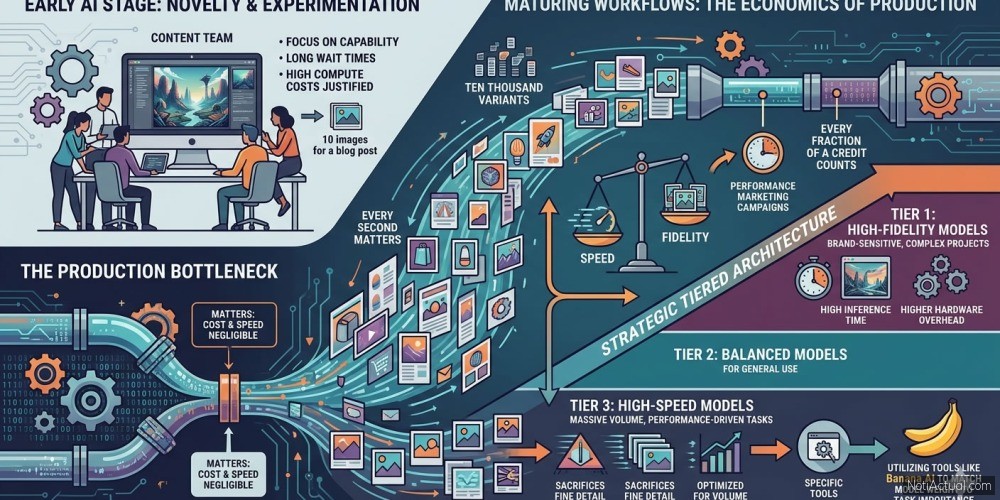
For most content teams, the bottleneck in generative AI isn’t the technology’s capability; it’s the math of production. In the early stages of the «AI boom,» the novelty of a single high-quality image was enough to justify long wait times and high compute costs. However, as workflows move from experimental side-projects to repeatable asset pipelines, the focus has shifted toward unit economics. When you are generating ten images for a blog post, cost and speed are negligible. When you are generating ten thousand variants for a performance marketing campaign, every second of latency and every fraction of a credit matters.
The tension between speed and fidelity creates a strategic fork in the road for creative operations. High-fidelity models, while impressive, often require significant inference time and higher hardware overhead. Conversely, high-speed models often sacrifice the «fine-grain» detail that brand-sensitive projects require. Balancing these factors requires a move away from the «one model fits all» mindset toward a tiered architecture that utilizes specific tools like Banana AI to match the model’s weight to the task’s importance.
The Hidden Costs of High-Fidelity Logic
We often talk about «quality» in AI as an objective peak, but for a production team, quality is a moving target defined by the output medium. A hero image for a landing page requires a different level of scrutiny than a background element for a 15-second social ad. Using a massive, multi-billion parameter model for every task is an inefficient use of resources.
The primary cost isn’t just the literal price per generation; it is the «iteration tax.» If a creator has to wait 45 seconds for a single generation, their creative momentum is broken. In a high-volume environment, a slow model limits the number of «shots on goal» a designer can take. If a team is trying to find the perfect composition, they are often better served by generating 50 low-fidelity previews in 30 seconds than waiting ten minutes for five high-fidelity results. This is where the concept of «distilled» models becomes essential for scaling.
Operational Speed and the Nano Strategy
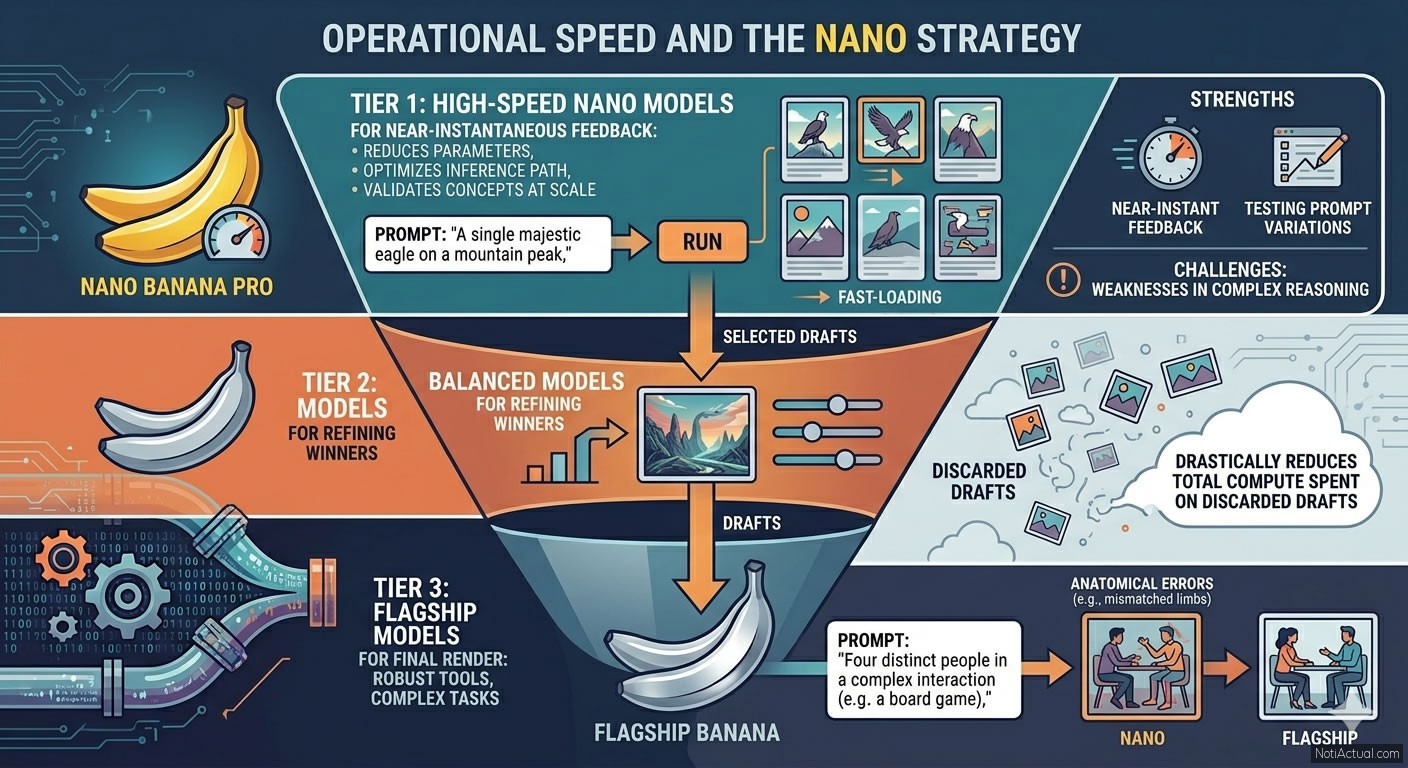
To solve the latency problem, many teams are moving toward smaller, specialized models that prioritize throughput. The use of Nano Banana Pro within a workflow allows for nearly instantaneous feedback. By reducing the parameters or optimizing the inference path, these «Nano» versions allow teams to validate concepts at scale before committing to the final render.
In practice, this looks like a tiered production funnel. Stage one uses a high-speed model to test prompt variations and composition. Stage two involves refining the selected «winner» using more robust tools. This approach drastically reduces the total compute spent on discarded drafts. However, there is a visible limitation here: smaller models like Nano Banana often struggle with complex spatial reasoning. If your prompt involves four distinct people interacting in a specific way, a high-speed model might produce anatomical errors that a larger model would avoid. Expecting «Nano» performance to match «Flagship» reasoning is a common mistake that leads to frustration.
The Illusion of Speed in Content Pipelines
One of the most significant risks in prioritizing speed is the «re-work trap.» If a model generates images in five seconds but produces usable results only 20% of the time, it is effectively slower than a model that takes thirty seconds but is right 80% of the time. Speed without a baseline of reliability is just a faster way to create digital waste.
Content teams testing generative media workflows must define their «quality floor.» This is the minimum level of fidelity required for a human editor to take over. Using a dedicated AI Image Editor at the end of the pipeline is often more cost-effective than trying to get the perfect «raw» generation from the prompt alone. It is almost always faster to fix a lighting issue or a minor texture error in a post-generation editor than it is to re-roll the prompt twenty times hoping for a miracle.

Este contenido ha sido creado por un humano, recomendamos consultar siempre primero a un humano antes que una IA.
¿Te gustó este artículo? ¿Quieres recibir notificaciones en tu correo sobre este tema?


Opciones para usuarios:
» Mide tu Velocidad de Internet aquí» Precio del Petróleo y otros Commodities:
» Precio del BITCOIN »
» Precio del DÓLAR
» Calculadora PayPal »
» Calculadora de Compras para Usuarios de Venezuela »
» Calculadora de Compras para Usuarios de España »
» Calculadora de Expectativa de Vida »
» Calculadora de Créditos »
» Consultar el Horóscopo Diario »
» Pronóstico del Tiempo
» Cronograma Original de Pensiones IVSS 2026
» BUSCAR CONTENIDOS
Sigue leyendo los temas más populares: