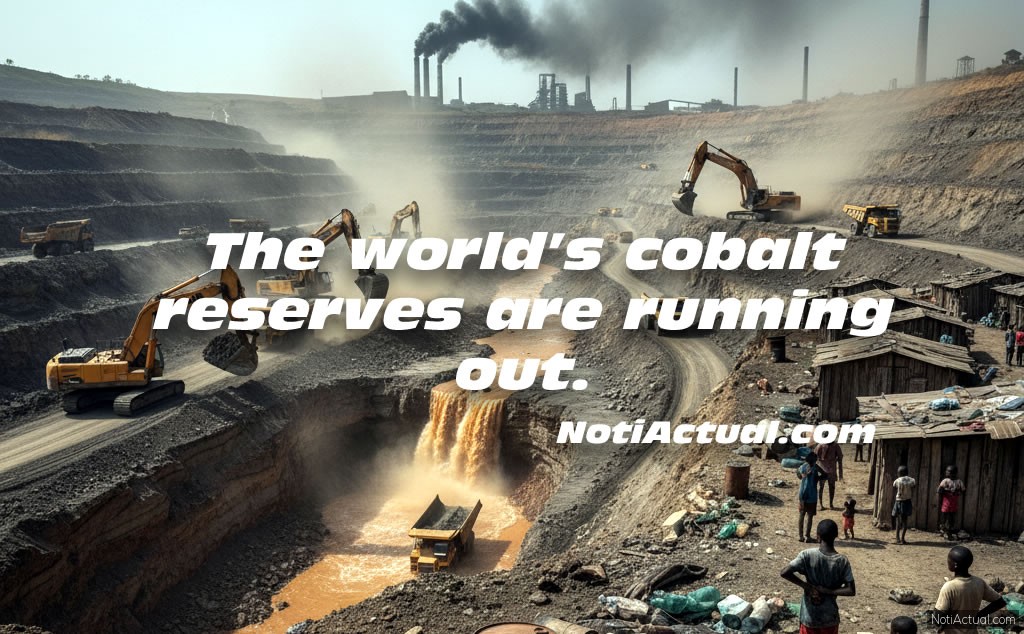
Cobalt depletion is forcing the global industry to seek a future without its most vital mineral.
Cobalt is a critical mineral that, although less well-known than lithium or copper, is equally strategically important, especially for the battery industry. Its supply situation is one of the most delicate in the world.
World Cobalt Reserves and Production
According to the most recent data from the United States Geological Survey (USGS) and other sources, global cobalt reserves amount to approximately 11 million metric tons . Global production in 2024 is estimated at approximately 230,000 tons .
The cobalt situation is unique due to the high concentration of its deposits in a single country.
◄ Scroll hotizontal disponible en esta Tabla ►.
| Country | Reserves (Metric Tons) |
Annual Production (Metric Tons)
|
| Democratic Republic of the Congo (DRC) | 5,600,000 | 170 |
| Australia | 1,700,000 | 5 |
| Indonesia | 500 | 45 |
| Cuba | 500 | 3,5 |
| Filipinas | 260 | 4 |
| Russia | 250 | 6,5 |
| Canada | 220 | 3,5 |
Note: The DRC produces more than 70% of the world’s cobalt, creating a critical dependency for the global supply chain.
Importance and Industrial Uses of Cobalt
The importance of cobalt lies mainly in its magnetic properties, high strength and stability, which make it vital for:
- Batteries: It’s an essential component in the cathodes of lithium-ion batteries, where it increases energy density, stability, and lifespan. This is crucial for electric vehicles and consumer electronics (smartphones, computers).
- Alloys: Used in the manufacture of superalloys for aircraft turbines, cutting tools, and industrial machinery that operate at high temperatures and under extreme conditions.
- Dyes and Pigments: Their compounds are used to give an intense blue color to glass, ceramics and paints.
- Biomedical applications: It is used in surgical implants and prostheses due to its corrosion resistance.
Estimated Reserve Depletion
The depletion projection is a simplistic exercise based on current reserves divided by annual production.
- Depletion of global reserves: If annual production remains at 230,000 tons, the 11 million-ton reserves would last approximately 48 years .
However, as with lithium, the critical factor is growing demand. Demand for cobalt could increase significantly in the coming years, drastically reducing the reserve horizon. This situation of high concentration of supply in a geopolitically unstable region (the DRC), coupled with constantly increasing demand, makes cobalt a mineral of extreme concern.
Scenario of total depletion of industrially extractable cobalt reserves
A scenario of total depletion of industrially extractable cobalt reserves is a red flag that would have catastrophic and far-reaching consequences for the global economy and technology.
The Collapse of Key Industries
The first and most immediate consequence would be the paralysis of industries that depend on cobalt. The production of lithium-ion batteries , which are driving the electric vehicle (EV) and consumer electronics revolution, would come to a complete halt. Without cobalt, these batteries lose stability and energy density, making them unviable for many applications.
- Automotive industry: The transition to EVs would come to an abrupt halt. Factories would be unable to produce new electric vehicles, and the used market for existing EVs would explode.
- Consumer technology: Production of smartphones, laptops, and other electronic devices would be severely affected.
- Aerospace industry: Cobalt superalloys, crucial for aircraft turbines and rocket engines, would be phased out, compromising aircraft safety and production.
Economic and Geopolitical Chaos
With supply at zero, cobalt would become one of the most valuable and sought-after materials on the planet.
- Black market and speculation: The remaining cobalt in supply chains or in lower-grade deposits would be traded at exorbitant prices, generating a black market and uncontrolled speculation.
- Energy reconfiguration: A shortage of high-performance batteries would force economies to rely on less efficient or more polluting energy sources, reversing progress in the fight against climate change.
- Absolute power of reserve-holding countries: Nations that currently have large reserves (such as the DRC and Australia) would find themselves with unprecedented power and geopolitical influence, similar to that of oil in its day.
Forced Innovation and Long-Term Resilience
Despite the initial chaos, the depletion of cobalt would force humanity into radical technological and social change.
- Mandatory circular economy: Recycling lithium batteries would become the only way to obtain cobalt. «Urban mining» would be more valuable than traditional mining. Governments would likely mandate the recycling of any product containing cobalt.
- Alternative solutions: Research into new battery chemistries that do not require cobalt, such as lithium iron phosphate (LFP) , sodium-ion , or solid-state batteries , would be accelerated .
- Change in product design: Engineers across all industries would be forced to redesign their products to eliminate dependence on cobalt, which could lead to entirely new and unexpected technologies.
In short, a cobalt depletion scenario would be a global «red light» event that, while devastating in the short term, would catalyze a total transformation toward sustainability, recycling, and innovation, forcing society to become less dependent on a finite and concentrated resource.
Industries that would be paralyzed due to a lack of cobalt and an estimated reduction in the quality of modern life due to cobalt shortages
A cobalt shortage would cripple key industries and have a significant impact on the quality of modern life. The crisis would not only affect the industries that use it, but would create a domino effect throughout the global economy.
Industries that would be paralyzed
The absence of cobalt would halt production in sectors that rely on its unique properties in batteries and alloys.
- Electric Vehicle (EV) Industry: This is the most vulnerable industry. Cobalt is essential for the manufacture of high-energy-density lithium-ion battery cathodes. Without it, mass production of electric vehicles would grind to a halt.
- Consumer electronics manufacturing: Devices like smartphones , laptops, tablets, and portable power tools rely on batteries that use cobalt to extend their lifespan and stability. A shortage would cripple their production lines and drive up prices.
- Aerospace and Defense Industry: Cobalt is a key ingredient in superalloys used to manufacture aircraft engine turbine components, where high-temperature resistance is crucial. A lack of cobalt would compromise the manufacture of modern aircraft and defense systems.
- Medical sector: The production of some surgical implants and prostheses using cobalt-chromium alloys, known for their biocompatibility and corrosion resistance, would be severely affected.
Reduction of the Quality of Modern Life
Cobalt is running out: Shortages force a radical shift toward alternative materials in the battery industry.
A cobalt shortage would have a direct impact on our quality of life, affecting mobility, connectivity, and energy.
- Limited mobility: The expansion of electric vehicles would be halted, making it difficult to reduce dependence on fossil fuels. This would slow the fight against climate change and maintain air pollution in cities.
- Compromised connectivity: The lifespan and performance of portable electronics would decrease. Without efficient batteries, the constant use of connected devices that defines modern life would become more expensive and less reliable, creating a more pronounced digital divide .
- Power grid instability: The adoption of large-scale renewable energy sources (solar and wind) would be impacted. Without cobalt backup batteries, energy storage to stabilize power grids would be more difficult to achieve. This could lead to increased instability and a reliance on less sustainable energy sources to meet demand.
Is cobalt a technologically replaceable mineral?
The Cobalt Countdown: Will We Find the Perfect Replacement Before Reserves Run Out?
Strictly speaking, cobalt is not a completely replaceable mineral for all its applications. Although there is a significant effort in industry to reduce or eliminate its use, its unique properties make it very difficult to replace in certain critical contexts.
Context of the Substitution
The possibility of replacing cobalt depends on the sector. In the battery industry, where most cobalt is consumed, the search for alternatives is a priority.
- Electric vehicle batteries: In this field, lithium iron phosphate (LFP) batteries are gaining ground. These batteries are completely cobalt-free and cheaper to produce. However, their lower energy density makes them more suitable for standard-range vehicles or large-scale energy storage, rather than for high-performance vehicles.
- Superalloys and industrial uses: In the aerospace industry, for example, cobalt is essential for creating alloys that can withstand extreme temperatures and corrosion. In this field, finding a replacement with the same properties has been a much greater challenge.
Why is Cobalt Difficult to Replace?
Cobalt is a unique material that provides stability, safety, and high energy density to lithium-ion batteries. Without it, battery performance and lifespan are compromised.
Furthermore, its presence helps prevent overheating and degradation, making it vital for safety.
In conclusion, although the industry is investing heavily in «cobalt-free» or «low-cobalt» technologies , there is no direct substitute that can replicate all of its properties in all its uses. The goal is not to find a simple replacement, but to repurpose technologies to be less dependent on this mineral.
Sources consulted:
Cobalt Statistics and Information